Print this page

Welcome to the official website for the City of Pittston


                 City of Pittston to Collect for Toys for Tots


In order to better inform the residents of the City of Pittston, this web site was created. We hope all our residents will find this to be an important tool in increasing important knowledge of our City Government. We welcome your input and your support.


Pittston is a city in Luzerne County, Pennsylvania between Scranton and Wilkes-Barre. Pittston gained prominence in the past as an active coal mining city, drawing a large portion of its labor force from European immigrants.

History

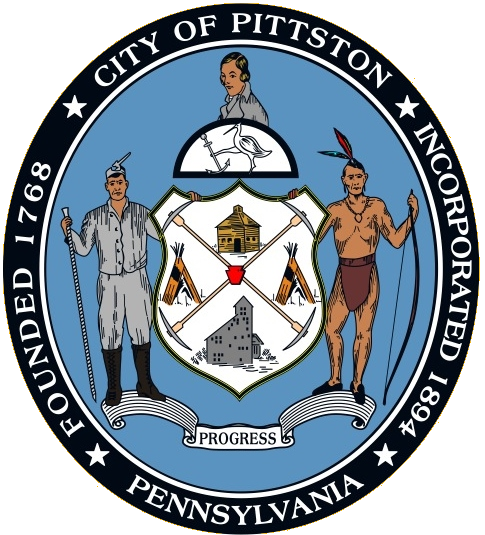
Pittston is the midpoint city between Wilkes-Barre and Scranton. Named after the famous statesman William Pitt, the city was laid out in 1768 and settled about 1770, was incorporated as a borough in 1855, and was chartered as a city in 1894.

Coal mining was active in Pittston until the Knox Mine Disaster in nearby Port Griffith in Jenkins Township, Pennsylvania on January 22, 1959 which played a key role in shutting down the mining industry in Northeastern Pennsylvania.

Geography

Pittston is located at 41°19′26″N, 75°47′20″W (41.323865, -75.788894)[1]. According to the United States Census Bureau, the city has a total area of 1.7 square miles (4.5 km²), of which, 1.6 square miles (4.1 km²) of it is land and 0.1 square miles (0.4 km²) of it (8.09%) is water. The city is served by the Pittston Area School District.

The area in and around Pittston is referred to as Greater Pittston and includes Avoca, Dupont, Duryea, Exeter Boro, Exeter Township. Hughestown, Jenkins Township, Laflin, Pittston, Pittston Township, West Pittston, West Wyoming, Wyoming and Yatesville.

Demographics

As of the census of 2000, there were 8,104 people, 3,530 households, and 2,170 families residing in the city. The population density was 5,072.6 people per square mile (1,955.6/km²). There were 3,902 housing units at an average density of 2,442.4/sq mi (941.6/km²). The racial makeup of the city was 98.38% White, 0.68% African American, 0.09% Native American, 0.31% Asian, 0.02%


Next page: General Information